
Get the ADHD Claim Check Field Guide
Understand the Questions to Ask Before You Believe another ADHD Headline
A free field guide to checking claims about ADHD online (or on TV).
If you’re feeling confused by all the conflicting information about ADHD on television and in the papers, it can be impossible to work out what you should believe. These are qualified people. So how do you tell whether you’re hearing the evidence, or one clinician’s view of it?
I’ve created this guide to help YOU ask the right questions when someone makes a statement about ADHD – everything from documentaries about ‘over diagnosis‘ to social media influencers talking about ‘object permanence‘.
This guide covers topics like: ‘Rising rates of what?’, ‘What good evidence looks like’ and ‘If this helps, is it ADHD?’ – plus references to where I got my information and links for more.
Once you’ve got the guide, you’ll have a set of questions that work for almost anything you can read in the press or online – and spot what people are NOT saying.
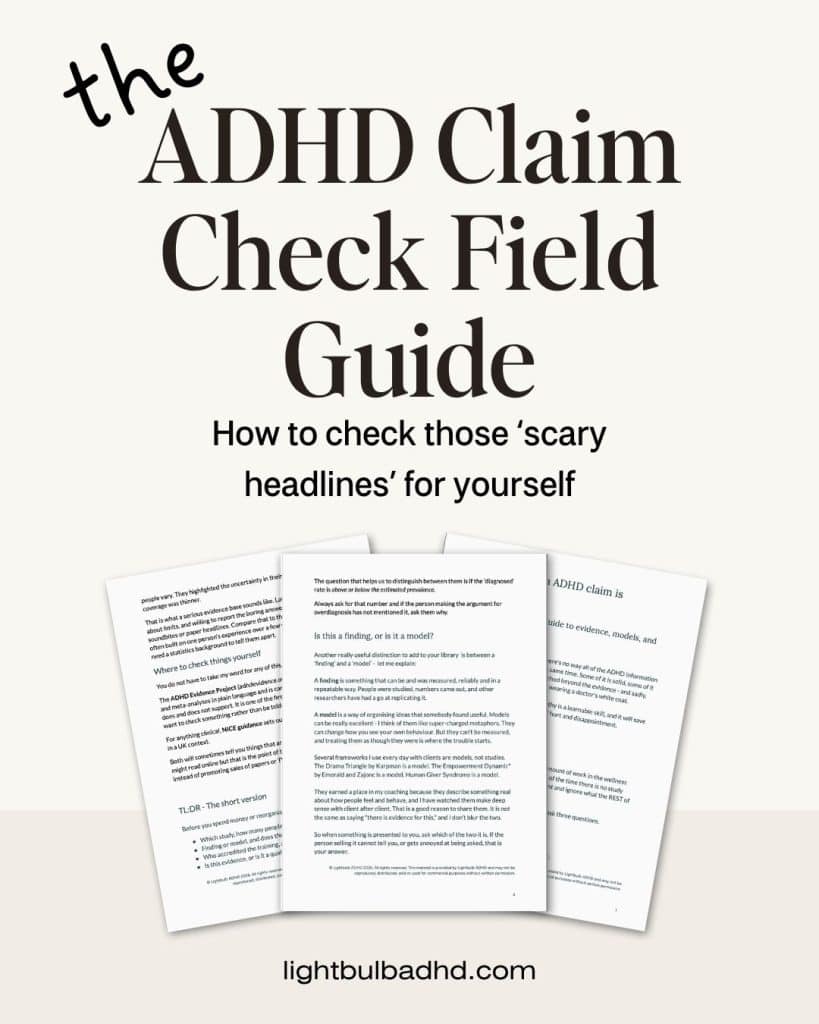

What’s Included:
The Claim Check Field Guide has



About the field guide
Why believe a ‘coach’?
I’m Katherine Sanders. I’m an ICF- PCC (professional certified coach) and one of a handful of PAAC-certified ADHD coaches in the UK.
I have an obscure PhD, six years of coaching late-diagnosed ADHD adults, as well as ADHD myself, so I’ve read the same headlines you have and had the same “wait, is that right?” reaction.
I published a white paper on ADHD coaching standards and an analysis of this industry, because the gap between what is claimed and what has evidence in this field is genuinely enormous.
This guide is the short version of how I approach headlines and ‘news’ before I believe them.
What can the Claim Check Field Guide help with?
01

Notice the difference between a convincing opinion and a fact
Everyone in the ADHD debate speaks with total confidence, so confidence isn’t useful information.
Once you know what a well-evidenced claim should have, the gap between someone using facts and someone sharing an opinion gets much more obvious, and you stop having to pick a side based on their tone of voice.
02

Only use evidence that is reliable when you want to take action
Every new headline has an implied instruction. ‘Buy this, cut that out, restructure your mornings, add this supplement’.
Use the Field Guide so that your energy, time and money go to what has evidence behind it.
03

Get ahead of the ‘well I heard’ conversations
If someone at work brings up a news headline, you don’t need to have memorised references. You need to have better questions for them – so they start to question those ‘scare quotes’ headlines.
That kind of steady confidence will stay with you long after the press have moved on to another target.
Ready to stop taking those ADHD claims at face value?
Once you click the confirm email in your inbox, the guide arrives straight away.
Over the following week I’ll send just two more emails: one idea that changes how a lot of people see their own ADHD, and one invitation. After that you’ll get my regular emails, and you can unsubscribe any time.