
You’re in the right place to get answers to your questions.
Here you’ll find quick answers to the most common things people ask about before working with me.
By Topic
Working Together and the Coaching Process
In 2026, I’m focused on one to one clients and my coaching studio clients. I have some spaces for coach mentoring and two new services for Young People.
One to One Clients: when you email or book a connection call, we will have a short conversation to ensure that I’m the right coach for you. If I don’t think I am, I will endeavour to find one or two other people for you to speak to.
After our call, I ask you take 48 hours to think before making a decision.
To go ahead, we’ll begin with a ‘Why Am I Like this?’ Review process, and again, you or I can decide that you are not ready or in the right place for coaching just yet.
To continue, I coach in three month commitments, on a rolling basis. My goal is to help you not NEED a coach – but I hope you’ll discover the VALUE of having a coach around and choose to continue working together.
Right now, my meetings are held online – usually using video.
However, my one to one clients also have asynchronous coaching – a fancy way of saying ‘you send me a thought; I send you a question or thought back; you think about it and reply’.
I have found that phone and voice note coaching is a powerful addition for ADHD clients, who experience the value of verbal processing for harnessing our brains ‘multi-channel’ thinking very clearly.
As I coach with people for a minimum of three months, we have options. To begin with, we will talk at least once a week. After a few weeks, usually our conversations will begin to spread out. Normally, clients know when they ready to move on from coaching because they can wait 3-4 weeks, or more.
I keep my one to one client numbers small so that I can offer ‘concierge’ type coaching – we will have a private communication channel to send notes, voice messages and it means within my working hours, I’m available to coach any challenges that arise or answer questions.
Each session is a structured, ADHD-friendly conversation led by what matters most to you.
We’ll check in, choose a focus for our time together, explore what’s really going on, and then decide what feels genuinely do-able next, including how you’ll look after yourself and your brain along the way.
What that actually looks like in practice
Although it will feel like a natural conversation, there is a clear structure underneath. A typical session usually includes:
- Arriving and checking in
We start by seeing how you are today, what’s been happening since we last spoke, and whether you feel in the right headspace for coaching. If you’re wobbly, we may slow down, simplify, or adjust what we’re aiming for in the session. - Choosing a focus for the session
We’ll agree a topic together. That might be:- Something you’ve brought with you (e.g. a work situation, a decision, a pattern you’ve noticed),
- Something that emerges as we catch up, or
- A piece of a longer-term theme you’re working on.
I’ll help you get clear on what you want from this hour – understanding, relief, a plan, a decision, or simply a bit more space around something that feels tangled.
- Exploring what’s really going on
Through questions, reflection, and occasionally simple tools or visuals, we’ll look at:- How your ADHD traits and nervous system are showing up here
- The stories you’re telling yourself about this situation
- The supports and constraints in your environment
This part can feel like thinking out loud with someone who’s genuinely tracking the threads with you and helping you find the path again if you wander off.
- Spotting the snags and supports
Before we talk about “doing”, we’ll look at what might get in the way – energy, time, executive function, other people, perfectionism, etc. We’ll name how you can work with your brain rather than against it, so you’re not setting yourself up to feel like you’ve “failed” again. - Landing on what’s next
“Next” doesn’t have to be a big, practical action. It might be:- A small experiment you’ll try
- A boundary or conversation you want to have
- A way of noticing or responding differently
- Or simply a clearer way of understanding yourself
We’ll finish by checking what feels realistic, how you’ll know you’re making progress, and what support you might need between sessions.
Every session is a bit different, because you’re different each time you arrive. The consistent thread is that it’s your agenda, your pace, your values – and my job is to hold a safe, well-structured space so your thinking can actually breathe.
This is based on what you have chosen to commit to. We work on experiments – what’s going to move you forward? What have you got capacity for?
Sometimes that will be a task you’re working on and yes, I’ll ask how it went. That’s as close to ‘homework’ as I like to get.
Often, yes – and it can work well – as long as:
You feel stable enough to actually take action from coaching (not in immediate crisis).
Your therapist knows you’re working with me.
We’re not pulling you in totally different directions.
How coaching and therapy can fit together
A simple way to think about it:
Therapy might help you understand and heal what’s underneath:
things like old patterns, trauma, anxiety, shame, or relationship dynamics.
Coaching with me focuses on:
“Okay, given all of that… how do we set up your days, work, and systems so life is actually more doable?”
You might use therapy to process a big emotional knot,
then use coaching to decide what boundaries, experiments, or habits you want to try in real life.
If you’re already working with another coach
Sometimes people come to me instead of another coach; sometimes they work with me alongside a different kind of support (for example, a business coach + ADHD coach).
This can work if:
You’re clear what each coach is for.
– You have enough time/energy to actually implement things (and if you’re not, I will ask you to notice that… not just keep you on my schedule)
– You’re not using multiple coaches to “fix you” but to support different pieces of your life.
– If I think you’re over-committing, getting conflicting advice, or using coaching when therapy would be safer, I’ll name that gently but clearly.
My first responsibility is that the work we do together is ethical, realistic, and genuinely supportive for you.
About ADHD Coaching
No – I coach the person in front of me, not their diagnosis. The most important thing is that you’re ready to change, try doing things differently and, ideally, have made a change in your life at least once before.
Not at all.
Many of my clients are diagnosed; many are still in the “is this ADHD?” stage, or stuck on waiting lists. What matters most is that your experience lines up with how I work, and that ADHD-informed coaching feels like a good container for you.
I have noticed that some clients find implementing changes gets easier when they’re able to accept their ADHD – and, for some, when they’re taking medication. It’s not essential, though.
Therapy and counselling are about healing and mental health.
Coaching is about change, experiments, and next steps.
A therapist or counsellor helps you process difficult experiences, manage symptoms (like anxiety or depression), and heal.
An ADHD coach sees you as a thinking partner and resourceful person who wants to build a life that fits your brain and your values.
Coaching is not a replacement for therapy, crisis services, or medical care.
A more detailed breakdown (for people who like detail)
Therapy / counselling usually focuses on:
Processing painful experiences, trauma, or long-standing patterns.
Managing symptoms that seriously affect day-to-day life.
Understanding why you feel the way you feel.
Therapists and counsellors are trained to:
Work with mental health conditions.
Hold clinical risk (e.g. self-harm, suicidal thinking).
Use specific therapeutic approaches.
Coaching usually focuses on:
Where you are now and where you want to go next.
How your brain, habits, and environment are actually working in real life.
Turning insight into practical experiments and next steps.
Building skills: self-trust, boundaries, planning, follow-through, self-advocacy.
We will absolutely talk about feelings in coaching (you are not a robot),
but the main question is:
“Given how your brain works and what matters to you…
what do you want next, and how can we make that easier to do?”
If, during our work together, it looks like therapy or another kind of support would be more appropriate, I’ll say so clearly and help you think through your options.
No – and I cannot ‘hint’ at a diagnosis or offer alternatives to medication.
Coaching is a conversation; I know a lot about ADHD, both through study, coaching and my personal experience.
However, a diagnosis in the UK can ONLY be carried out by medical professionals and medication can only be prescribed by qualified psychiatrists. This isn’t to make your life more difficult.
ADHD can look like lots of other challenges – some of them neurodevelopment, some of them mental health problems. It’s very important that you have a careful, thorough diagnosis to ensure any support or treatment you receive is the RIGHT one.
Money, Scheduling, Policies
Because of the type of coaching I offer, one to one coaching begins at £2400 for three months together. If this is across a break – for example Christmas – I will ensure you have three months of coaching and extend the date around our business holiday.
Payments are made each month or in a single instalment, whichever works best for you, in advance.
Yes, for my one to one clients, I accept a monthly payment each month. There is no additional charge for paying by instalment. The payment will be taken on the same day each month.
Ideally I ask clients to not cancel or reschedule within 24 hours of our meeting.
Life happens – kids get sick, cars break, and sometimes these things cannot be avoided. In those circumstances, we aim to reschedule either the same week or as soon as possible.
If you are regularly having trouble making it to sessions, we will have an honest conversation about your situation before deciding if you are ready to continue coaching.
When you begin our coaching partnership, you sign a commitment for three months. In our initial conversation, we will check that you are in a position to focus on coaching – it is NOT a good idea if you have significant life events coming up or other matters that will cause disruption and are not our coaching focus.
If unexpected things happen and you need to pause coaching, we address each situation on a case by case basis.
Accessibility, Ethics, Safety, Neurodivergence
My coach training is with ADHD as a speciality – however, I have worked with Autistic and AuDHD clients in the past and I am diagnosed with Autism and ADHD myself. We are all different in how our diagnoses present so I do not make assumptions before meeting.
My focus is on the person, not your diagnosis.
However, my coaching might not be for you if you
– struggle with visual metaphors
– have significant problems with flexible thinking or imagination
– want a coach to explain what other people are thinking or why they behave that way.
This is another reason that I only work with one to one clients after a connection call, ‘Why Am I Like This?’ Review and careful consideration.
Do not hesitate to contact me if you have more questions about this.
Firstly – I am also an ADHD, Autistic adult. Annoyed – no. Understanding? Yes.
Secondly – I will not wait for client for more than ten minutes from the start of our scheduled coaching time. I send a link to our meeting before hand to make sure you find it easily and understand how difficult time keeping can be.
If you are regularly late, we will discuss what is happening and if the current approach is right for you.
I have tried to minimise the number of forms and platforms clients need to use BUT in order to gather useful information before we begin work, there are self-rating scale questions that are part of our intake.
If you struggle with forms and admin, I absolutely understand and am happy to talk about what you need to succeed. I can either offer alternatives or support you with the forms. Just drop me an email to discuss more.
When coaching, clients must be able to use email, online video meetings and secure payment software. These are kept as simple as possible to support you but there are some limits on how much we can reduce the technology burden.
Coaching with me works best when you’re safe, curious, and ready to experiment. It’s not the right fit if:
- You’re in acute distress or crisis.
If getting through the day feels impossible, you’re dealing with very low mood, or you’re worried about your safety, you need medical / mental health support first, not coaching. - You need diagnosis, medication, or formal reports.
I don’t diagnose ADHD, prescribe medication, or provide medico-legal reports for tribunals, HR disputes, or court. Coaching is about how you live with your brain, not clinical assessment. - You want to be ‘fixed’ or made more productive at any cost.
If your main goal is to become “normal,” push harder, and override your limits with hacks, my approach will probably annoy you. I won’t help you squeeze more out of yourself by ignoring your wellbeing. - You’re only here because someone else thinks you should be.
Coaching doesn’t work well if you’re just ticking a box for a partner, boss, or parent. You need at least a little personal buy-in and curiosity for our work to land. - You want change without any reflection or experimentation.
You don’t need huge homework, but you do need to be willing to notice what’s going on, try small experiments, and be honest about what you find. If you’re sure “nothing will work anyway,” this may not be the right season.
Whatever we discuss in sessions is confidential – it will not be discussed with your employer, family, or anyone else – by me.
If you want to tell someone else about what we discuss or what you are working on, that is absolutely okay.
The only occasion where confidentiality is limited is
a) when you have explicitly asked me to communicate with another person and any information shared will be checked by you first of all or
b) if your behaviour or conversation suggests that you are a serious risk to yourself or another person/people. In that case, I will check that you are aware of this and let you know that unless you can get support on your own behalf, I may be required to let someone else know.
This is to ensure client safety, not breaking ‘confidentiality’.
Many of us with undiagnosed ADHD have experienced trauma. It can cause many significant mental and physical problems.
Some circumstances mean that I would NOT work with someone who has significant or ongoing trauma or PTSD. This might sound unfair but your welfare and success is my top priority, always.
If you have any questions, you are welcome to email me, in confidence, before arranging a call.
Over the last few years I have found more and more clients are in a state of burnout.
Because it is both increasingly common AND something that I have experienced, I am currently undertaking a certification in Coaching Burnout clients with Dr Neha Sangwan, a renowned expert and medical doctor who has developed a comprehensive Burnout Recovery and prevention protocol. Burnout Coaching for ADHD clients will launch in Spring 2026 but is already part of my practice.
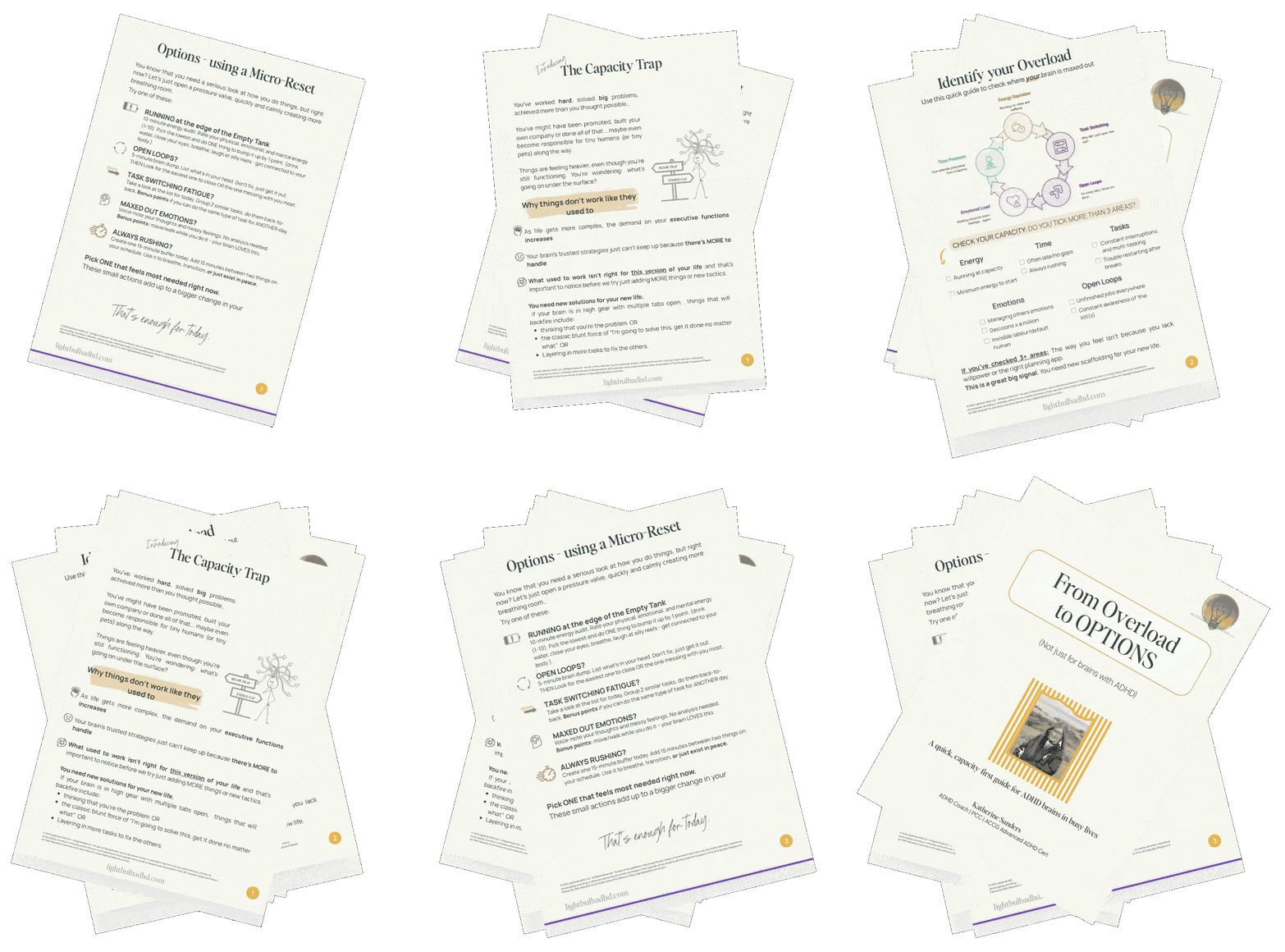
Get from “Overload to Options” in this new Guide.
Would you like to save this?
Email this to yourself, so you can come back to it later!